
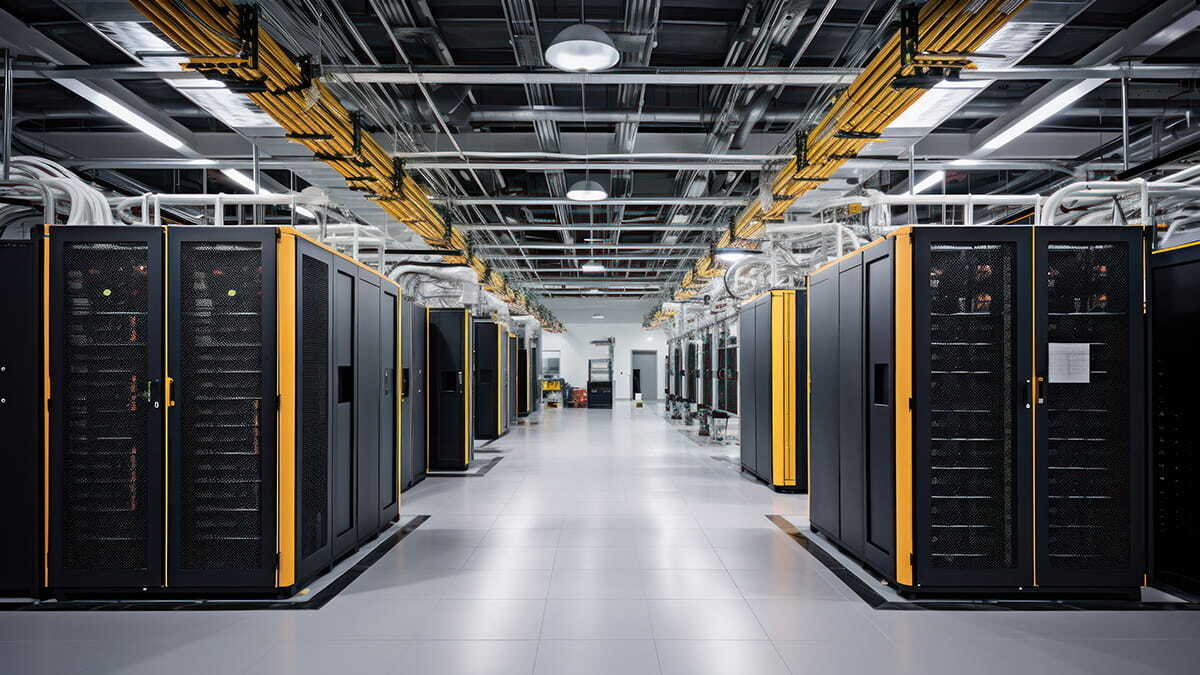
The Digital Surge Meets a Thirsty City: Navigating the Hydrological Cost of Mumbai's Data Center Boom
The Mumbai Metropolitan Region (MMR) has emerged as the epicentre of India’s data centre boom. Nearly 60% of India’s data centres are located in and around Mumbai, particularly in Navi Mumbai and Thane. However, as hyperscale facilities continue to proliferate, an equally critical question is beginning to attract attention: Can the region sustainably meet the water requirements of this digital infrastructure while serving a growing urban population?
Geography of the Data Centre Cluster
The traditional hub remains the TTC Industrial Area, where industrial land, fibre connectivity, and reliable electricity have created an ecosystem for cloud and colocation providers. Driven by Mumbai 3.0 strategic master plans, development is now tracking aggressively south into Panvel and peripheral development zones, further accelerated by the upcoming Navi Mumbai International Airport logistics corridor. To capture global enterprise investments, the state government has extended unparalleled real estate and power incentives. Under the Maharashtra IT & ITES Policy 2023 and its strategic 2024 amendments, operators are granted:
- Up to 100% stamp duty exemption for greenfield property or facility acquisitions
- Substantial electricity duty waivers alongside industrial power tariff subsidies
- Relaxed Floor Space Index (FSI) allocations and preferential localized property tax brackets within Maharashtra Industrial Development Corporation (MIDC) zones
- Streamlined single-window regulatory clearances to fast-track build cycles
However, what these policies grant in ease of business, they frequently leave unhedged in terms of systemic resource safety nets.
The Hydrological Reality and Environmental Disparities
India’s structural resource profile features a stark mismatch: the nation houses roughly 18% of the world’s population but holds access to only 4% of global freshwater reserves.
A small 1 MW data centre using traditional cooling can consume an estimated 26 million litres of water annually, equivalent to the domestic needs of roughly 528 people. A typical 100-MW hyperscale facility can consume approximately 2 million litres of water per day for on-site cooling alone. When extrapolated across Mumbai’s operational and pipeline capacity, the cumulative demand is staggering. Industry estimates suggest data centres across India consumed 150 billion litres of water last year, a figure poised to double by 2030.
The critical issue is not merely consumption but source. Data centres rely heavily on evaporative cooling, a process in which roughly 80% of withdrawn water is lost to the atmosphere and does not return to the local basin.
In a city where only 4% of the metropolitan region receives 24/7 water supply and over 71% of residents get water for less than four hours a day, the disparity is stark. Slum areas receive just 45 litres per person per day compared to 135 litres in wealthier neighbourhoods.
Monsoons, El Niño, and Uncertainty
Mumbai’s foundational water grid is fundamentally a hostage to seasonal monsoon cycles. The city draws water from seven lakes — Upper Vaitarna, Modak Sagar, Tansa, Middle Vaitarna, Bhatsa, Vihar, and Tulsi — and recent reports show reservoir levels have fallen to critical lows, prompting BMC restrictions on construction, swimming pools, and water use by industrial and commercial users. That makes every new large water consumer more sensitive from a planning perspective.
Compounding this baseline stress, the Thane-Belapur corridor is increasingly experiencing distinct micro-climate anomalies. The heavy physical grouping of dense, hot-air exhausting data center units creates localized "data heat islands". Micro-climate field studies reveal that surface temperatures immediately outside these facilities typically spike by 2°C to 4°C, and can surge up to 9°C higher than ambient natural baselines, with thermal plumes traceable up to 10 kilometers away.
Industry Response and Voices on the Ground
Operators argue that the industry is improving. Many say they are shifting to advanced cooling systems such as liquid immersion and air cooling, which reduce freshwater use. Others point to recycled wastewater and public-private partnerships that use treated sewage water instead of potable supply. These are important steps, but transparency remains limited, and actual water consumption is often difficult to verify independently.
On the ground, the contrast can be stark. In Panvel, some residents awaiting rehabilitation still rely on broken pipelines, while hyperscale facilities are supplied continuously. In Cheetah Camp, residents have voiced concern about rising electricity bills even as industrial demand increases. This is why the debate is not just about infrastructure; it is also about fairness, allocation, and environmental justice.
Regulatory Gaps and Society’s Response
India still lacks a mandatory national framework for assessing the environmental impact of data centres. Environmental clearances are handled by State-Level Environment Impact Assessment Authorities (SEIAA) but monitoring and transparency are often weak. Maharashtra does require water-supply NOCs, groundwater monitoring, and minimum renewable-energy use, but these conditions are usually project-specific and do not capture cumulative stress across a whole corridor or watershed.
There are also signs of broader tension in the region. The Kalu Dam proposal, for example, has triggered resistance from Adivasi communities and raised questions about how future water demand will be met. That matters because it shows the pressure is not abstract; it is already shaping land, water, and community politics.
Conclusion
The lesson for Mumbai is simple: the social licence to operate is not a slogan. It is a political reality. The Maharashtra government can either strengthen its regulatory framework now or wait until public pressure forces a more disruptive correction. Three priorities emerge: transparent water disclosure before approval, watershed-level cumulative impact assessment, and genuine community engagement rather than procedural consultation.
Mumbai should also adapt recycled or non-potable water for cooling wherever possible, apply tariffs that discourage freshwater abstraction, and mandate third-party water audits with public reporting. Digital growth does not need to stop, but it must be aligned with hydrological reality. The cloud can thrive in Mumbai, but only if the taps do not run dry.